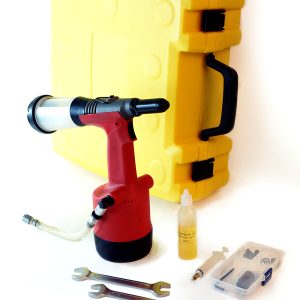
Manual, pneumatic, and battery-powered riveters for every need and type of job.
Tools designed to deliver performance, durability, and comfort in every application.
We offer manual, pneumatic, and battery-powered models to adapt to various professional or industrial work demands.
Maximum Strength
High-quality materials for intensive and prolonged use.
Ergonomic
Design conceived to facilitate work and reduce effort.
Versatility
Compatible with different types and sizes of rivets.
Technical Support
Guidance to choose the ideal tool according to your application.
Choose the right riveter for your job.
Lightweight and easy to use. Ideal for occasional or low-volume jobs.
Higher speed and power. Ideal for production lines and industrial environments.
Portable, powerful, and no compressor needed. Maximum mobility.
Designed for jobs requiring greater force and durability.
We help you find the ideal fastening tool for your project or production line.
The choice depends on the volume and type of work. For occasional repairs, a manual riveter is sufficient. If you have a production line, the pneumatic riveter offers greater speed. For construction sites or assemblies where you need to move freely, the cordless battery-powered riveter is the best option.
Pneumatic riveters operate using compressed air supplied by a compressor, providing continuous use at maximum power, which is ideal for fixed workshops. Battery-powered tools deliver the same force without the need for cables or hoses, making outdoor or high-altitude work easier, depending on their battery life.
Our riveters include interchangeable nozzles to work with different diameters, generally ranging from 2.4 mm (3/32") to 6.4 mm (1/4") depending on the selected tool model. Check the technical sheet of each model for its exact range.
Yes, pneumatic riveters require a stable air supply at a specific pressure (generally between 5 and 7 bar) to function. We have compatible compressors and hoses available as additional accessories.
It is recommended to periodically clean the internal jaws, apply lubrication to the moving mechanical parts, and, in the case of pneumatic ones, check the hydraulic oil level of the circuit to ensure a full traction stroke.
Absolutely. As top-tier manufacturers and distributors, we ensure a continuous stock of replacement jaws, nozzles for all sizes, traction springs, and official technical service for all our equipment.
Our team will advise you on choosing the best fastening tool.